

Malaysia’s infrastructure pipeline has moved decisively from political uncertainty to execution-stage deployment. Three concurrent programmes — the ECRL’s renegotiated commercial terms, the Ministry of Transport’s final approval of MRT3’s Circle Line, and a hyperscale data-centre corridor now drawing committed institutional capital in the tens of billions — define what is arguably the most substantive infrastructure buildout cycle the country has seen in two decades. For co-investors evaluating hard-asset exposure in Southeast Asia, the timing, funding architecture, and demand underpinnings of each programme merit precise analysis.
ECRL Reset: Commercial Terms and Regional Connectivity
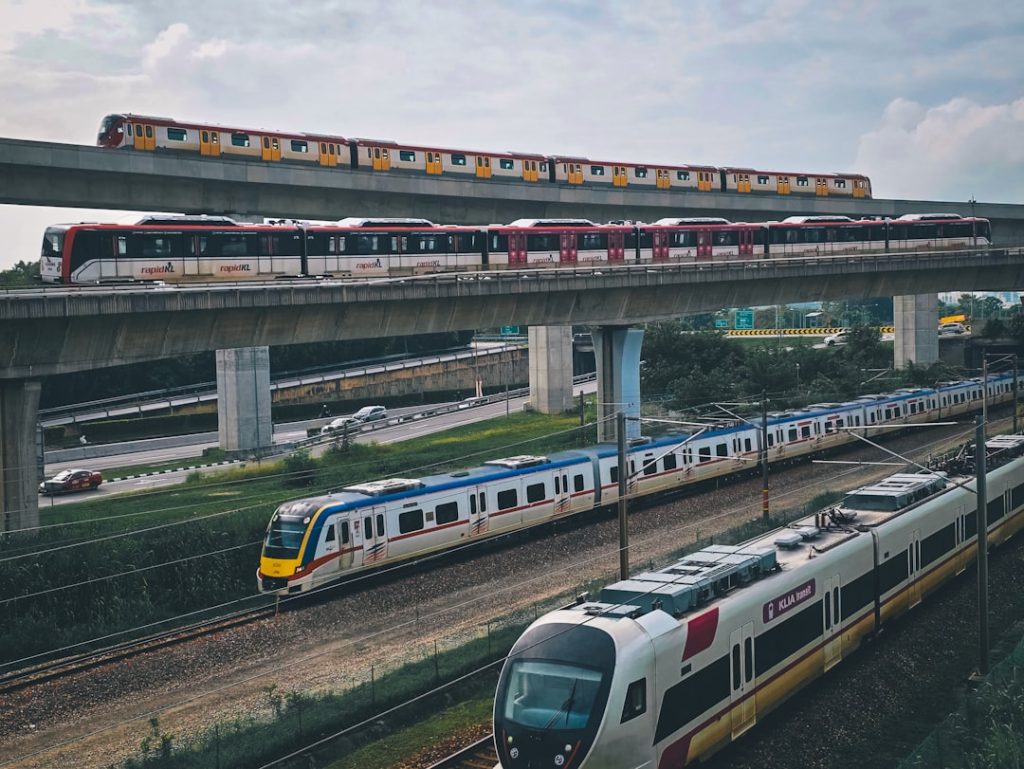
The East Coast Rail Link has emerged from three rounds of cost renegotiation with a revised all-in programme cost of RM74.96 billion — representing a reduction of RM11 billion against the original 2016 estimate of RM85.97 billion. The recalibration, formalised under the Anwar administration in December 2022, was achieved through value engineering, route realignment on Section C (Temerloh–Serendah–Port Klang), and contract scope adjustments with China Communications Construction Company (CCCC).
The RM74.96 billion total comprises RM50.27 billion in construction cost and RM24.69 billion in other development costs, which include interest during construction, land acquisition, utility transfer fees, and operating expenses. The project’s financing architecture centres on a term loan from China EXIM Bank structured over 20 years at a 3.25 percent interest rate with a seven-year repayment moratorium. That moratorium has since been extended: the loan’s grace period was extended to 2027, with the interest rate remaining unchanged.
On a physical execution basis, Phase 1 of the 665km ECRL line reached 86.07% completion as of July 2025. The standard-gauge double-track link connects Port Klang on the Straits of Malacca to Kota Bharu in northeast Peninsular Malaysia, carrying both passengers and freight. At the operational level, passenger trains running at up to 160km/h will cut travel time from Kota Bharu to ITT Gombak to approximately four hours.
The connectivity thesis extends beyond domestic mobility. The ECRL’s original alignment is expected to reduce shipping time for international freight transiting from China to Europe via Malaysia by as much as 30 hours — a materially significant parameter for logistics operators assessing the Kuantan Port–Port Klang land bridge. The ECRL’s SDG Sukuk framework, rated “Gold” by MARC for its environmental and social contributions, also introduces a green financing dimension that broadens its appeal to ESG-mandated institutional capital. The project is anchored by an RM10.21 billion government-guaranteed SDG Sukuk, complemented by the soft loan from China EXIM Bank.
The commercial viability question, however, remains a material variable for underwriters. The former Transport Minister projected five million passenger rides and 26 million tonnes of cargo freight per annum in the ECRL’s first five years — a forecast that analysts have characterised as optimistic relative to existing KTM throughput data. Economic Accelerator Projects focusing on industrial parks, logistics centres, and transit-oriented development were launched to drive corridor demand, while Malaysia Rail Link entered a joint venture with CCCC for operations and maintenance. Demand ramp-up modelling, particularly cargo yield per tonne-km, will be a central underwriting variable for any secondary-market infrastructure debt positions that emerge post-commissioning.
MRT3 and Urban Mobility Capex in Kuala Lumpur
MRT3 has cleared its most structurally significant milestone since cancellation in 2018: on 17 July 2025, Transport Minister Anthony Loke formally approved the Final Railway Scheme, clearing the way for land acquisition and setting the project on a construction trajectory that capital markets are already pricing into Malaysian contractor equities.
The 51.6km MRT3 Circle Line will serve as the final piece of the Klang Valley Mass Rapid Transit network, forming an orbital route around Kuala Lumpur featuring 31 stations — 10 of which are interchange stations — integrating with existing MRT, LRT, KTM, and Monorail lines, with 40km elevated and 11km underground. The line is designed to support up to 25,000 passengers per hour per direction, with a full circuit expected to take 73 minutes.
On cost and funding, the picture has been materially repriced from its 2018 baseline. The project had an estimated total cost of RM68 billion in 2018, but the government is now targeting a cap under RM45 billion, with approximately RM31 billion allocated for construction and RM6–7 billion for land acquisition. Funding is expected to involve DanaInfra Nasional debt issuances rather than the earlier proposed hybrid model, in a move to lower financing costs. MRT Corp has indicated it is also exploring alternative funding models including public-private partnerships, in line with the government’s fiscal strategy under Budget 2025.
Construction timelines have been clarified: “Construction of MRT3 may begin in CY2027, which will keep contractors busy possibly up to 2033,” with contract awards expected towards the end of the land acquisition process between end-2026 and mid-2027. Both MBSB Research and RHB Investment Bank note the MRT3 timeline will dovetail well with the expected completion of the Johor-Singapore Rapid Transit System and the ECRL by end-2026, ensuring continuity in sector activity.
For institutional co-investors, the land acquisition compression is a significant bankability signal. The number of land lots required was reduced from 1,012 to 690 — a 31 percent decrease — following the public inspection exercise. Reduced compulsory acquisition exposure lowers sovereign-interface risk and shortens the critical-path timeline between financial close and construction commencement. The project adopted an “Intermediate MRT” (i-MRT) system technology with shorter 4-car trainsets and tighter turning radii to significantly reduce land acquisition requirements — an engineering-driven cost optimisation that directly improves project-level IRR at the same revenue assumptions.
The Data-Centre Corridor: Hyperscale Demand and Grid Capacity

Malaysia’s digital infrastructure sector has graduated from aspirational positioning to confirmed capital absorption at scale. Valued at US$4.04 billion in 2024, the Malaysian data centre market is projected to exceed US$13.5 billion by 2030, with Malaysia securing US$23.3 billion from North American hyperscalers alone across the first 10 months of 2024. The geographic concentration of this capital is bifurcated: Johor anchors the southern node, while Kuala Lumpur and the Klang Valley — including Cyberjaya — retain critical mass in network density and enterprise cloud services.
Malaysia’s data centres are concentrated in two main corridors — the southern tip of Johor bordering Singapore, and the Klang Valley urban expanse from Kuala Lumpur to Port Klang, including Cyberjaya. As of 2024, 1.8 GW of early-stage supply was distributed between Kuala Lumpur and Johor Bahru in a roughly 55:45 split. Kuala Lumpur had a planned capacity of 960 MW as at end of H1 2025. On the grid side, the pressure is acute and explicitly acknowledged in TNB’s capital programme: accelerating demand has driven RP4 infrastructure spending to RM15 billion in FY2025 and RM42.8 billion over the full RP4 period (2025–2027), reinforcing a multi-year grid investment upcycle.
As of September 2025, TNB had signed 49 Electricity Supply Agreements with data centre developers representing a total future demand of 7.1 GW. The demand ramp is steep: data centre utilisation on the grid increased to 485MW in March 2025 from 148MW a year earlier. Grid emissions intensity — coal and gas representing the dominant generation mix — remain a sustainability risk variable that ESG-mandated operators must address through direct renewable procurement under the Corporate Renewable Energy Supply Scheme (CRESS), introduced in September 2024.
| Metric | Data Point | Source / Period |
|---|---|---|
| Malaysian data centre market value (2024) | US$4.04 billion | White & Case / 2024 |
| Projected market value (2030) | US$13.5 billion | White & Case / Forecast |
| North American hyperscaler commitments (10M 2024) | US$23.3 billion | White & Case / 2024 |
| Total FDI from data centre projects (2021–2024) | RM184.7 billion (US$43.6 billion) | ISEAS / MIDA |
| TNB signed ESAs (Sept 2025) | 49 projects / 7.1 GW total demand | TransitionZero / TNB |
| Actual grid load (March 2025) | 485 MW | Kenanga / TNB |
| TNB RP4 capex (2025–2027) | RM42.8 billion | TNB / Dec 2024 |
| Johor data centre pipeline (H1 2025) | 2,570 MW | JLL / H1 2025 |
| Kuala Lumpur planned capacity (H1 2025) | 960 MW | JLL / H1 2025 |
| Projected data centre demand by 2035 | >5 GW | TNB / Kenanga Research |
Institutional financing at the project level is increasingly sophisticated. In the first half of 2025 alone, two global data centre operators raised a combined US$6.3 billion in fresh funding: Bridge Data Centres secured US$2.8 billion in March 2025 to accelerate hyperscale development in Malaysia and Thailand, while DayOne Data Centres closed a US$3.5 billion multicurrency financing package in June 2025 to support its green data centre expansion in Johor. These are not speculative venture commitments — they are contracted-revenue financings underwritten against executed Electricity Supply Agreements and hyperscaler offtake.
The grid capacity constraint is the sector’s most material execution risk. Projections indicate that data centres could consume as much as 20 percent of the country’s total electricity capacity. Grid renewables cover just 19 percent of national generation, with coal and gas representing 81 percent of supply, limiting issuance of corporate PPAs despite the 2024 Green Electricity Tariff. Operators with grid connectivity secured, ESAs in place, and renewable procurement structuring completed occupy a materially different risk position than those still queuing for TNB capacity allocation.
Funding Structure and the Role of Regional Capital

Malaysia’s infrastructure pipeline is being capitalised through a layered structure of sovereign debt, DFI lending, domestic pension capital, and private institutional co-investment — a multi-source architecture that distributes risk and improves bankability across project phases.
At the sovereign level, Malaysia’s total FDI position surpassed the RM1 trillion mark by close of 2025, with approved investments for the first nine months of 2025 totalling RM285.2 billion, representing a 13.2% increase year-on-year. Johor, Selangor, and Kuala Lumpur emerged as the primary beneficiaries of this investment wave, drawing significant capital inflows across multiple industries. The investment quality signal is notable: the services sector’s dominance reflects Malaysia’s growing importance as a regional hub for data centres, digital infrastructure, and corporate headquarters, as well as the continued expansion of financial services and logistics capabilities.
For the MRT3 programme, the financing model is transitioning toward DanaInfra-issued debt instruments — a structure that concentrates sovereign credit risk on the balance sheet while theoretically opening upstream construction packages and downstream asset-management concessions to private capital. The ECRL, by contrast, remains anchored by bilateral sovereign lending, with the MRL’s SDG Sukuk providing a domestic fixed-income instrument that ESG-focused fixed-income allocators can access directly.
Regional capital flows reinforce the macro thesis. ASEAN’s infrastructure investment needs are estimated at USD 2.8 trillion by 2030, and Malaysia — as ASEAN Chair in 2025 — has deployed that positioning actively in capital market roadshows from London to Tokyo. State-owned enterprises (GLCs) play a significant role in the Malaysian economy and have been used to spearhead infrastructure and industrial projects, providing co-investment structures that allow international LPs to take minority positions alongside government-linked anchors with sovereign balance-sheet backing.
The data centre sector specifically demonstrates how institutional co-investment can achieve scale rapidly when commercial structures are in place. AirTrunk’s total Malaysian investment has reached RM9.7 billion, following its December 2024 acquisition by a partnership between Blackstone and the Canadian Pension Plan Investment Board in a A$24 billion deal — a transaction that illustrates precisely how large-cap institutional infrastructure vehicles are gaining operating-platform exposure to Southeast Asia’s digital infrastructure buildout. IFC, the World Bank Group’s private-sector arm, deployed a senior loan of up to US$150 million to finance the first phase of a 300 MW data centre campus by Yondr Group in Johor — a DFI-anchored financing that reduced perceived country risk and facilitated commercial lending participation.
Currency exposure on infrastructure projects denominated in ringgit requires explicit hedging consideration. USD-denominated construction inputs, hyperscaler offtake sometimes contracted in USD, and MYR-denominated sovereign financing create a multi-currency exposure stack. For LPs with USD-denominated fund structures, the ringgit’s historic trading range and Malaysia’s liquid forward FX markets provide manageable, if not eliminable, basis risk.
Partnership Pathways for Strategic Co-Investors

Malaysia’s recalibrated infrastructure pipeline presents a differentiated entry point for institutional capital — one defined not by frontier-market speculation, but by contracted demand, government-backed project structures, and execution timelines that are now materially de-risked relative to prior cycle starts. The ECRL approaches commissioning with 86% physical completion; MRT3 has cleared its most contentious planning milestone with 93% public support; and the data-centre corridor has ESA-backed demand of 7.1 GW already secured with TNB.
The opportunity set spans multiple risk-return positions: upstream construction financing in the MRT3 programme (highest return potential, contractor-credit risk), ECRL corridor Economic Accelerator Projects (real estate and logistics development, longer demand ramp), and contracted data centre co-investment structures (lower execution risk, tighter spreads, hyperscaler-backed cashflows). Each demands a different underwriting framework and a different set of local execution capabilities.
At Millennium Group, we engage with institutional capital on mandate design across each of these infrastructure layers — from project-level co-investment in digital infrastructure to LP-structure entry into Malaysia’s broader real assets pipeline. Our team maintains active positions in regional infrastructure networks and can provide transaction-level diligence support alongside macro-structural framing for LPs evaluating first-time or incremental Malaysia exposure.
We invite qualified institutional investors and strategic co-investors to contact Millennium Group to request a dedicated Malaysia Infrastructure Investment Briefing, tailored to your mandate parameters, risk appetite, and preferred entry structure. Our team engages directly with co-investment discussions rather than generic advisory relationships — execution depth and local capital-network access are the differentiators that separate returns from regret in this market.
Frequently Asked Questions
What is the current cost and completion status of the ECRL project?
As of July 2025, Phase 1 of the 665km ECRL was 86.07% complete. The all-in project cost was recalibrated to RM74.96 billion under the Anwar administration in December 2022 — a reduction of RM11 billion from the original 2016 estimate. The project is financed primarily by a 20-year term loan from China EXIM Bank at 3.25% interest, with a repayment moratorium extended to 2027.
When will MRT3 construction begin and what will it cost?
The Transport Ministry approved MRT3’s Final Railway Scheme in July 2025. Land acquisition is targeted for completion by end-2026, with construction scheduled to begin in 2027 and the line expected to be operational by 2032. The government is targeting a revised cost cap under RM45 billion, with approximately RM31 billion for construction and RM6–7 billion for land acquisition. Funding is expected to involve DanaInfra Nasional debt issuances.
How large is Malaysia’s data centre investment pipeline?
Malaysia’s data centre sector attracted RM184.7 billion (US$43.6 billion) in investment between 2021 and 2024. As of September 2025, TNB had signed 49 Electricity Supply Agreements representing 7.1 GW of future demand. The Malaysian data centre market is valued at US$4.04 billion in 2024 and projected to exceed US$13.5 billion by 2030. Johor holds a 2,570 MW pipeline while Kuala Lumpur has 960 MW of planned capacity as of H1 2025.
What are the key risks for institutional investors in Malaysia’s infrastructure sector?
Key risks include ECRL revenue ramp-up uncertainty (passenger and freight demand projections remain optimistic relative to existing KTM throughput), grid capacity constraints for data centre operators given TNB’s heavy fossil-fuel generation mix, MYR/USD currency exposure on USD-denominated construction inputs, and execution timeline slippage in MRT3 land acquisition. For data centre investments, ‘speculative applications’ and the gap between ESA-secured capacity and actual load utilisation present stranded-asset risk.
How can international co-investors access Malaysia’s infrastructure pipeline?
Entry structures vary by programme. MRT3 offers upstream construction financing opportunities through major contract packages. The ECRL corridor’s Economic Accelerator Projects provide real estate and logistics development exposure. Data centre co-investment can be accessed through direct platform stakes, project-level financing alongside DFIs such as IFC, or LP positions in institutional vehicles such as those operated by Blackstone and CPPIB. Malaysia’s GLC co-investment framework allows international LPs to take minority positions alongside government-linked anchors.

